
QWAQWA – For Maria Mokoena, a municipal worker who has spent years keeping public spaces clean, a new mechanical broom represents more than a piece of equipment. It offers relief from the physical demands of a job she has performed with ordinary brooms for years.
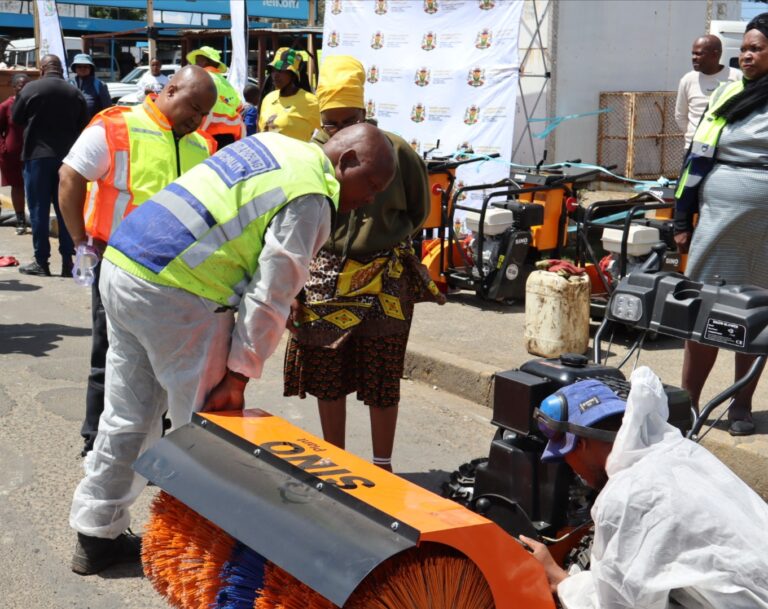
Mokoena, 52, was among the workers who stood to benefit from the Free State government’s service delivery intervention in Maluti-a-Phofung Local Municipality on Thursday, 8 October, when MEC for Cooperative Governance and Traditional Affairs (CoGTA) and Human Settlements Saki Mokoena handed over road maintenance equipment to the municipality.
“I am grateful to the MEC for this mechanical broom because this work is difficult,” said Maria, who has been permanently employed by the municipality since 1 December 2017.
She initially worked as a grass cutter and in foliage maintenance before moving to flower planting, street sweeping and maintaining municipal parks. Over the years, she has relied on ordinary brooms, sometimes short and sometimes long, to keep public spaces clean.
The mechanical broom is expected to make her daily work easier, highlighting how investments in municipal infrastructure can also improve the working conditions of the people responsible for maintaining communities.
The equipment handover formed part of the provincial government’s broader intervention to strengthen municipalities’ capacity to maintain roads and respond to service delivery challenges. The municipality received three tar cutters, three plate compactors, two walk-behind rollers, a mechanical broom and a truckload of asphalt.
The day was spent repairing potholes at designated sites across Phuthaditjhaba, starting in the Setsing central business district, where damaged road surfaces affect motorists and other road users.
MEC Saki Mokoena said the intervention was aimed at helping municipalities address persistent road maintenance problems while strengthening their ability to carry out repairs themselves.
“The Free State government, on the side of CoGTA, is rolling out what we call service delivery interventions in municipalities,” he said.
He explained that the programme focused on pothole repairs and improving municipalities’ local capacity to maintain infrastructure, particularly along major routes used by residents travelling to work and shopping areas.
The equipment is intended to support road cutting, compaction, asphalt application and street sweeping, enabling municipal teams to respond more effectively to deteriorating road conditions.
Mokoena emphasised that the intervention was not simply about handing over equipment but ensuring that municipal employees put it to use in their own communities.
“We are working with the municipality right here to make sure that we don’t just deliver them at the workshops of the municipality. Bring them inside. They work here. Make sure that employees of the municipality work with them,” he said.
He added that the province was taking the intervention to other municipalities, with the aim of addressing service delivery concerns that residents repeatedly raise, particularly the municipality’s ability to repair potholes regularly and maintain roads.
The MEC also pointed to the need for appropriate equipment for municipal workers, recalling how seeing an employee sweeping streets with an ordinary broom had prompted the decision to provide a mechanical alternative.
For workers such as Maria, the intervention brings the promise of a more manageable working day. While pothole repairs are visible signs of improved road maintenance, the provision of equipment for street cleaning also recognises the often-overlooked labour required to keep towns clean and public spaces usable.
As municipal teams continue repairing roads around Phuthaditjhaba, the impact of the intervention will ultimately be measured not only by the number of potholes filled, but also by the municipality’s ability to maintain the roads and public spaces residents depend on every day.